
The origins of Timor-Leste coffee - by Karst Organics
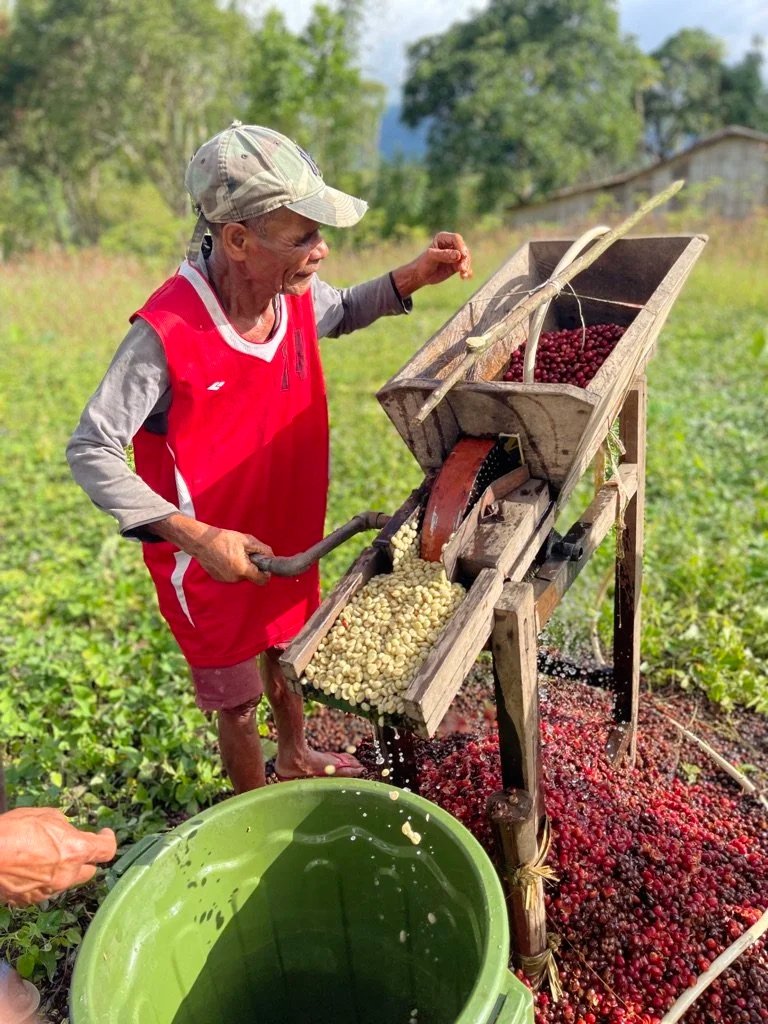
Coffee was first introduced to Timor-Leste by the Portuguese and by the 1900s was the island’s biggest export. However, the industry suffered greatly during the years of Indonesian annexation when the sector was largely ignored. Fast forward to the present day and the coffee farmers of Timor-Leste are working hard to collectively carve out a place for Timorese coffee in the global speciality coffee market, as well as replenishing and rehabilitating their coffee forests which were so overlooked during the struggle for independence during the latter part of the twentieth century.
One of the most special features about East-Timorese coffee is that it is all organically grown underneath the imposing Ai-Kakeu (Casuarina) and Ai-Samtuku (Albizia) shade trees that dominate the mountainous coffee growing regions. Only natural fertiliser is used (consisting of chicken poo, cherry skin and soil) to nourish the soil and due to the country’s lack of development and strong animist beliefs, chemical fertilisers have yet to be introduced into agricultural practices.
With time old traditions in processing coffee, passed on from generation to generation, coffee is gradually helping to build up more opportunities for Timorese people to create a consistent and sustainable income from which to support and provide for their families and the local community.
The statue of Cristo Liurai (Christ the King) dominates Letefoho, keeping a watchful gaze over the region’s coffee forests and mountain communities. Located in the western part of the sub-district, it is here that you will find the 18 members of the Cristo Liurai group, all of whom live around the southern perimeter of the steep Cristo Liurai mountain. Karst first entered into partnership with this group in 2020 and six years on, continues to work collaboratively with this community of smallholder farmers led by lead farmer Luis Santos de Jesus.
2025 saw a further increase in purchase price from 2024’s $3.50/kg to $4.00/kg and as a result, each of the Cristo Liurai members have experienced an increase in return from their coffee. This was particularly evident as this year’s harvest unexpectedly produced considerably higher yields. However, this was largely due to favourable weather conditions rather than the result of widespread rehabilitation work. This highlights the need for further coffee tree rehabilitation activities to be carried out in order to ensure that yields such as this, become part of the norm and not an anomaly. Encouraging Luis and his members to implement this will be one of Karst’s priorities for 2026.
Fully washed is the mainstay of Timorese coffee processing, which ultimately relies on stable access to large amounts of water. Sadly, direct access to a consistent water supply is not a given in Timor-Leste and this is especially evident in mountainous regions such as Letefoho. With this in mind, Karst has begun to look at how we can provide support with water storage. A predominant recurring issue is the need to collect water from the closest water source, which can be as far as two to three kilometres away. As an initial short-term solution, Karst has supplied a 2500L water tank to the community to collect rain water during the rainy season (December to April,) which can then be later accessed during the dry season for personal use, as well as coffee processing. Whilst only a short-term solution, it will suffice until a more suitable long-term solution is found.